
Contractor or Employee? The Superannuation Risks of Worker Misclassification

In Australia, many small and medium-sized enterprises (SMEs) - particularly in Nails & Beauty, Construction, and Hospitality - prefer hiring workers as independent contractors to reduce payroll costs and administrative burdens.
The common model involves:
Workers providing an ABN (Australian Business Number)
Issuing weekly invoices
The business not paying Superannuation
No Annual Leave or Sick Leave entitlements

However, a dangerous misconception persists: Having an ABN and issuing invoices does not automatically make a worker a Contractor.
If the Australian Taxation Office (ATO) or the Fair Work Ombudsman determines the actual nature of the work is an employment relationship, your business could face:
Back-payment of all unpaid Superannuation for several years
Interest charges and significant penalties
Strict investigations into breaches of workplace laws
This is currently one of the most significant payroll and tax advisory risks for SMEs in Australia.
I. Contractor vs. Employee: Key Differences
To determine the status of a worker, the ATO looks beyond the written contract and focuses on how the working relationship operates in practice.

Case Study: If a nail technician works fixed hours (5-6 days a week), follows a roster set by the salon, and uses the salon’s equipment but is asked to invoice via an ABN - the ATO may determine the worker is an employee. The owner will then be liable for all back-dated Superannuation and interest.
II. The Superannuation Trap: Contractors Can Still Qualify
Many business owners mistakenly assume that having an ABN automatically removes Superannuation obligations. However, you may still be legally required to pay Superannuation for a contractor if:
The worker is hired mainly for their labour
Payments are based on hours worked rather than a fixed project outcome
The worker does not operate as a genuinely independent business
III. What Is Superannuation Guarantee Charge (SGC)?
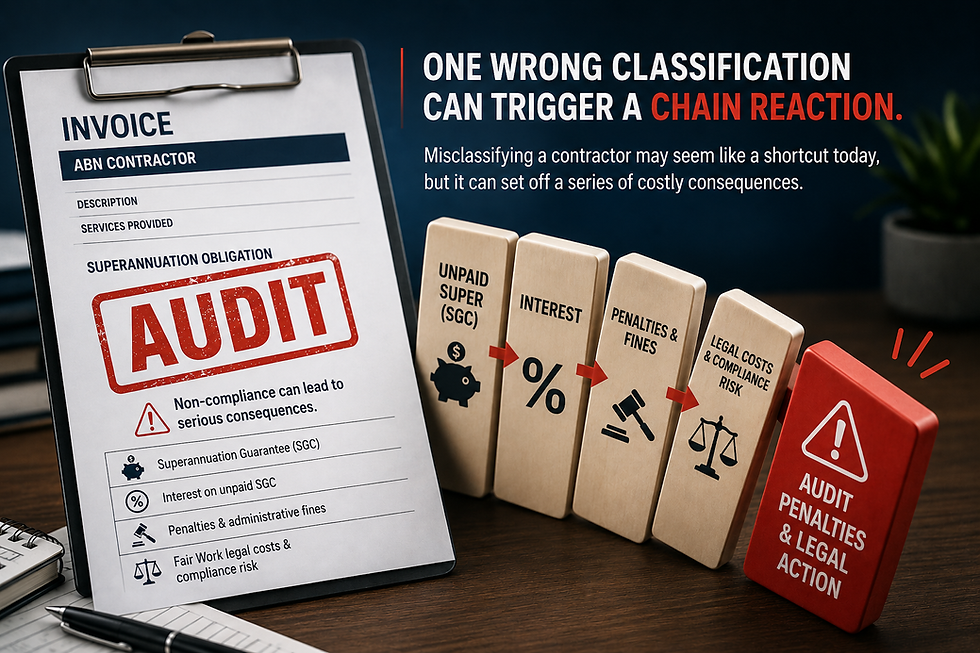
When the ATO reclassifies a contractor as an employee, the business must pay the SGC, which includes:
Unpaid Superannuation contributions
Interest charges
Administration fees
Additional penalties
The serious issue is that:
SGC is generally not tax deductible
Businesses can be audited and backdated for multiple years
Interest and penalties increase significantly over time
Many business owners only discover the problem when:
A worker resigns
There is an internal dispute
The business is audited
A complaint is made to the ATO or Fair Work
A new accountant reviews the payroll system
IV. Fair Work & Sham Contracting Investigations
The risk is not limited to tax. In addition to the ATO, the Fair Work Ombudsman may investigate cases involving:
Sham contracting arrangements
Avoidance of employee entitlements
Breaches of workplace laws
Businesses may be required to:
Backpay all unpaid Annual Leave and Sick Leave
Pay Significant Civil Penalties (often exceeding the tax liabilities)
Correct all historical underpayments of wages under the relevant Modern Award
V. High-Risk Industries
The ATO and Fair Work are currently increasing audits in sectors with high contractor usage:
Cleaning & Facilities Management
Nail, Hair & Beauty Salons
Hospitality (Cafes, Restaurants, Hotels)
Delivery & Transport Services
Trade Services (Carpentry, Plumbing, etc.)
Healthcare Support Services
Construction

VI. What Should Businesses Do Now?
Misusing ABNs is a threat to your business’s financial health and reputation. To protect yourself:
Don’t Rely on Verbal Agreements: Even if a worker "prefers" ABN to get a higher rate, the law protects their status as an employee if the facts fit.
Use the ATO Decision Tool: Regularly review your staff using the official Employee/Contractor Decision Tool.
Formalize Agreements: Ensure genuine contractor agreements clearly define autonomy, insurance, and the right to sub-contract.
Consult an Expert: Payroll compliance in Australia is complex. Professional tax advisory can help businesses avoid significant financial and compliance risks.
How We Can Help
We specialize in securing the future of Australian SMEs through:
Payroll compliance reviews
Contractor vs. Employee risk assessments
Superannuation obligation reviews
Strategic tax advisory for SMEs
The cost of fixing a payroll issue after an ATO audit is often significantly higher than reviewing it early. If you are unsure whether your workers are correctly classified, now is the time to review your payroll structure before problems arise.


Comments